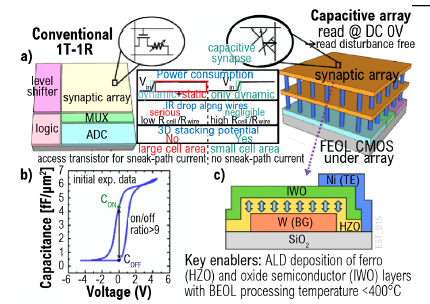
Thrust 1: Materials and Devices That Merge Memory and Logic in Three Dimensions
Thrust 1 focuses on discovering new pathways towards merging memory and logic functionalities of novel materials and devices into dense 3D integrated circuits for energy efficiency gains and to implement a new paradigm called algorithm-flow computing. Utilizing novel heterogeneous integration and low temperature synthesis techniques, the PIs in this thrust will integrate non-silicon devices on silicon platform into 3D
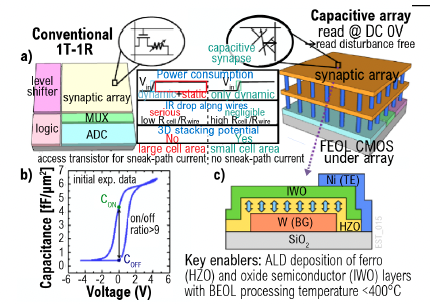
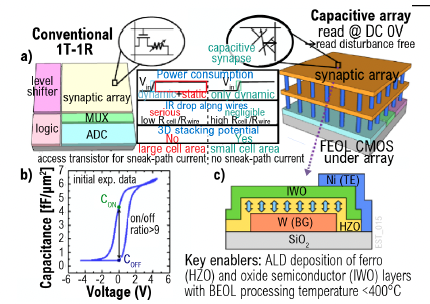
systems that solve computationally challenging problems across large, agile, and distributed datasets with unprecedented energy efficiency. Datta and McIntyre will research low-temperature (BEOL-compatible) atomic layer deposition (ALD) of inorganic materials for complementary (p- and n-type) metal oxide circuits, to enable reconfigurable bi-directional interconnections for global interactions, aided by design guidelines from members of ESTEEM’s Co-design Crosscut. ALD of ultrathin layers will be explored as a method of interface engineering for workfunction tuning in both logic and memory devices. Hwang will synthesize and integrate novel insulator-to-metal phase transition materials via epitaxial growth and layer transfer. Salleo will explore bio-inspired electrochemical devices where ion insertion into organic semiconductor channels enables precise conductance tuning to implement dense synaptic connections. The proposed research in this thrust addresses all three of ESTEEM’s key hypotheses, described in the project narratives.