Characterization Crosscut
Utilizing advanced, multimodal characterization workflows, the PIs in this thrust will pursue a campaign effort to map chemical and structural heterogeneity over widely varying length and time scales and determine their effects on device-relevant properties, variability, and process-performance relationships. Baniecki,
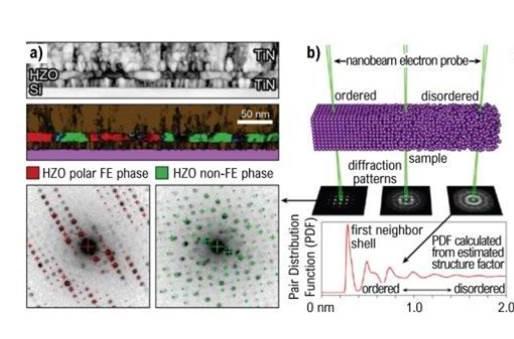
Gleason, McIntyre, and Ophus will link structure and chemistry across length scales to neuromorphic switching functionality of n- and p-type metal oxide semiconductors, FET capacitive synapses, and the epitaxial p-type oxides explored in Thrust 1. This effort will combine grazing incidence X-ray methods and pair distribution function analysis by McIntyre and Baniecki with advanced electron microscopy methods of Ophus including nanobeam STEM, new machine learning (ML)- based methods to extract quantitative atomic distributions from disordered materials, and inverse multislice ptychographic reconstruction. Gleason will employ novel light source coherent diffractive imaging (CDI) techniques, both synchrotron and XFEL-based, to allow visualization of emergent crystallization behavior to see strain profiles, map composition, phase and micro- to nanostructure in 3D. Salleo and Ophus will provide new insights into the effects of ion insertion on electrochemically active materials by spectroelectrochemistry, operando synchrotron X-ray methods, and cryo-TEM characterization. Gleason will complement the cryo-TEM characterization at the Angstrom- to few nm-scales by employing CDI methods spanning 10 nm- to 100s of μm-scales. Using in-situ X-ray studies, nanobeam electron diffraction, and CDI-based techniques McIntyre, Baniecki, Ophus, and Gleason will map structural phase boundaries of perovskite and fluorite structured ferroelectric materials and explore nonlinear optical performance relationships to identify candidate photonic materials to be integrated with the novel metasurfaces designs explored in Thrust 2. Insights obtained from the activities in Thrust 4 will guide the design of synthesis and thermal processing conditions employed in Thrusts 1 and 2. They will also provide input for the Co-Design Crosscut for computational prediction of the variability of critical materials properties as a function of device dimensions –a key issue for dimensional scaling of energy efficient microelectronics.


